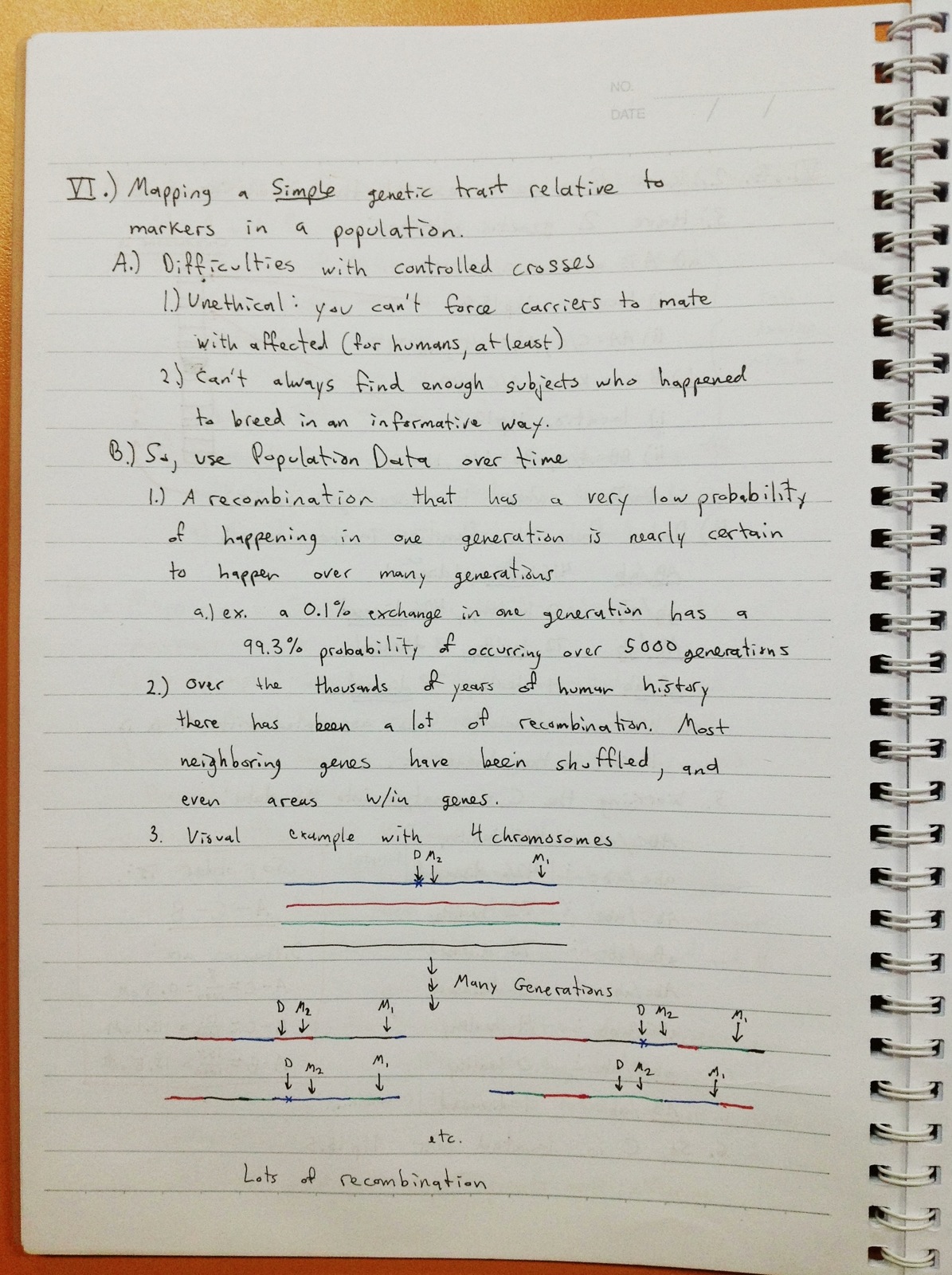
This week covered some basics about mutations and mutation rates, as well as how we attempt to map complex traits, such as polygenetic traits. Not so different from mapping simple traits, except looking all across the genome at rather weak signals for association.
One thing I just want to point out about this week's lectures: Dr. Noor's explanation for why there would be a normal distribution is one of the clearest explanations of the normal distribution I've ever heard. Again, an obvious idea in hindsight, but never explained so clearly to me. It's in the 3rd page of notes. :)
18 February 2013
Intro. to Genetics and Evolution Week 3 Notes
This week's topics were all about recombination and genetic mapping. There's quite a bit here, as a lot of it was new to me and the ideas are pretty cool. I can't help but think, "why the hell did I never learn any of this in my university genetics class???" Granted some of the ideas, such as those involving SNPs were only possible after the human genome project (which wasn't complete until after I'd graduated), but still. There's a lot of stuff about linkage and recombination fractions that should have been covered.
However, I have independent confirmation that my university genetics class was pants. So, it's not just a matter of me not having paid attention. ;)
There's a lot of good stuff here. Some of it kind of mind-blowing, and I'm really glad I'm learning it, even if I should have learned at least some of it before. Notice the marked increase in note-taking. ;)
Intro. to Genetics and Evolution Week 2 Notes
Oops. I've been taking Dr. Mohammed Noor's "Introduction to Genetics and Evolution" course on Coursera. I was supposed to have been posting these as I went along in the course, but here we are 6 weeks in, and I'm only just now getting around to it. No notes from the first week, as it was all introductory material with which I'm already familiar.
These week 2 notes are rather sparse as well, but there was at least one new thing to learn.
I can't believe a.) that I'd never been taught that you could simply multiply monohybrid probabilities for each gene in a dihybrid (or presumably any number of traits) cross, and b.) it never even occurred to me that this could be done, as it seems really obvious in hindsight. Ah well, now I know it and can pass it on to my high school students next year. :)
16 December 2012
Practicing Macrophotography
Whoops. Meant to post this a long time ago. Started the draft and then never got around to finishing it or IDing any of the species. For now, enjoy the pretty pictures. :)
A very tiny jumping spider (seriously, only a few millimeters):
A very pretty damselfly.
Damselfly nymph, perhaps?
I AM ANT, HEAR ME RAWR!!
Ant without the flash diffuser.
Ants with the flash diffuser.
You tryin' to take a picture of me?
Another ant.
Hey, look, an ant!
Did someone mention ants?
Some species of ladybird beetle.
Again with the ladybird.
Oh hai!
So, yeah, nothing about the biology of these things at the moment. Just the pictures. Enjoy.
01 August 2012
The Art of Natural Selection: Gecko Camouflage
On a tree by the bus stop at the front of the village where my school is, I am often lucky to get to see one close-up hanging out there. I always get a kick out of how well they match the tree bark. They look like the texture of lichens growing on bark, and they can vary their coloration to match the general background color. Here are several pictures of this.
![]() |
| You may recognize this from above |
![]() |
| The dangers of moving from light to dark backgrounds. Notice the tail still blends really well. |
![]() |
| From a different angle with different contrast, it blends in better |
![]() |
| If this one hadn't moved, I probably would not have seen it at all |
![]() |
| Nearly blended with the area to the left |
![]() |
| A near perfect match |
| Close-up of Singapore Ants using the Olloclip Macro |
If the geckos are eating these, then it would be a nearly constant, reliable food source.
Oddly, I cannot find any good research papers about the mechanisms or evolution of their color changing ability. As for the pattern, regular variation plus natural selection would easily mould variable spots and lines into the lichens-on-bark (or pebbles on sand, in a different background) pattern we see.
A rather simple, common thing to see, but no less awesome for that.
27 July 2012
Ostracod under the 'scope
So, I recently got an Arcturus Labs "Magnifi" iPhone case/microscope adapter mount in order to more easily take photos using the microscopes at school. This morning, I managed to grab some decent photos and a bit of video of an Ostracod. Check it out:
And the video:
Neat!
And the video:
Neat!
Subscribe to:
Posts (Atom)